 Stakecasino
 seed rotation for verifying past bets
Updated:Stakecasino reveals the previous server seed after rotation, enabling retrospective verification of supported casino bets. The check uses that revealed value, the client seed recorded for the bet, its nonce, and the game-specific calculation. Comparing the revealed seed with the hash published before play checks the commitment; reproducing the recorded outcome checks the calculation.
Table of contents
Rotation separates a seed's active use from its later disclosure. A usable verification record combines the commitment published before a bet with details available afterward. Future bets use the replacement server seed.
Bottom line: A matching server seed hash can coexist with an incorrect outcome calculation if the historical client seed or nonce differs.
A seed pair across successive bets
A seed pair supports successive bets because an incrementing nonce changes the input to the outcome calculation. Each bet belongs to its particular server seed and client seed combination. The nonce distinguishes calculations within that sequence, so its value alone cannot identify an outcome across different seed pairs.
The server seed and its commitment
The platform generates the server seed and keeps its active value hidden. Its published hash provides a commitment without disclosing the input needed to calculate upcoming results. Hashing the later revelation tests whether it corresponds to that commitment.
The client seed and historical nonce
The client seed contributes the player-controlled input and can be edited, while the nonce advances as new bets use the seed pair. A historical calculation needs the values belonging to the particular bet being checked. The account's current settings can describe a different combination. Bet records therefore matter even when the game and the visible result are familiar.
When does rotation make a past bet verifiable?
Rotating the active server seed reveals its previous value for retrospective verification. The platform generates a replacement for subsequent play, while the revealed value supplies the secret input needed to reconstruct completed bets made under the old commitment. A record containing only the active seed's hash is insufficient for that calculation because it lacks the underlying server seed.
Disclosure concerns the retired seed. The replacement belongs to subsequent bets and cannot substitute for the server input recorded for an earlier outcome.
From revealed inputs to game events
The seed-pair generator combines the server input with the client seed, nonce, and a round counter through HMAC-SHA256. HMAC means hash-based message authentication code and combines a key with a message. Here, the server seed supplies the key. Repeating the same inputs reproduces the byte stream, which the game then translates into its own outcomes.
Bytes, fractional values, and the cursor
The conversion consumes four bytes for each generated fractional value. Those values range from zero up to, but excluding, one. HMAC-SHA256 produces 32-byte blocks, and the cursor selects the relevant position within the generated stream. When a game requires values beyond the current block, generation continues into another block. The internal round counter advances when generation needs another HMAC block; the nonce continues to identify the same bet. One bet can therefore contain several generated game events.
The selected game's outcome mapping
Dice translates a generated value into a roll, while Plinko derives directions for the ball's path. Mines uses a shuffle to generate tile positions without repeating selected positions. These mappings give the same underlying stream different meanings. A verifier must use the mapping for the game being checked, including any configuration the mapping requires. A raw fractional value is an intermediate calculation, not automatically the result shown in the bet record.
A matching commitment and a matching result
The commitment comparison tests the disclosed server input; outcome reconstruction tests the recorded game event. A seed hash can match even when the outcome calculation uses the wrong client seed, because that seed does not participate in the server commitment.
A retired seed and a changed client input
Suppose a reader asks whether matching the server seed hash already verifies a completed bet. All record contents and comparison outcomes in this example are hypothetical. The saved record contains the pre-bet commitment, historical client seed, nonce, and displayed game event. Rotation has supplied the old server seed.
Hashing the revealed seed produces the saved commitment. An initial outcome calculation uses a different, current client seed and produces a different event. The commitment comparison passes, while the calculated event does not match the recorded outcome.
Using the recorded client seed with the old server seed, original nonce, and correct game mapping reproduces the saved event in this case. The two matches confirm both the committed server input and the reconstructed event for this bet's seed-pair implementation.
Different kinds of verification mismatch
A mismatched seed hash concerns the commitment comparison, while a mismatched game event concerns outcome reconstruction. Keeping these failures separate makes the affected input easier to identify. Neither discrepancy should be dismissed merely because another part of the calculation matches.
A commitment comparison failure
A hash mismatch can follow from copying the wrong revealed seed or pairing it with another historical commitment. Seed values are exact data, so altered characters matter. The comparison needs the commitment associated with the bet's server seed. A hash published for the replacement seed describes a different value and cannot authenticate the old one.
An outcome reconstruction failure
A matching commitment still leaves the client seed, nonce, byte selection, and game mapping to reconcile. The published generator uses the client seed as part of an exact message, so changing its characters changes the calculation's input. Selecting another game also changes the interpretation of generated values. Custom code must preserve the input strings and separators used by the generator, including the round counter in its message. If a discrepancy persists, retain the original bet details and identify the failed comparison before treating the result as verified.
Verification coverage and unchanged payout rules
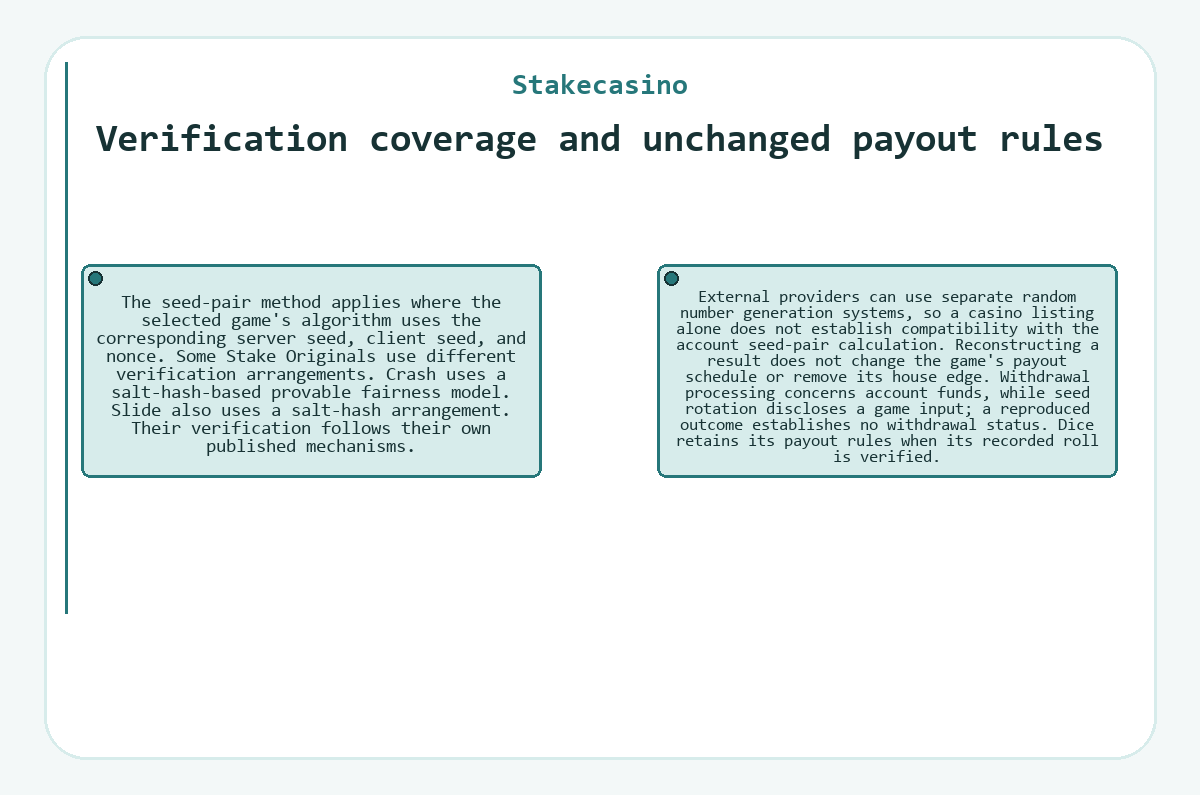
The seed-pair method applies where the selected game's algorithm uses the corresponding server seed, client seed, and nonce. Some Stake Originals use different verification arrangements. Crash uses a salt-hash-based provable fairness model. Slide also uses a salt-hash arrangement. Their verification follows their own published mechanisms. External providers can use separate random number generation systems, so a casino listing alone does not establish compatibility with the account seed-pair calculation.
Reconstructing a result does not change the game's payout schedule or remove its house edge. Withdrawal processing concerns account funds, while seed rotation discloses a game input; a reproduced outcome establishes no withdrawal status. Dice retains its payout rules when its recorded roll is verified.
Stakecasino: reader questions
Can I verify a past Stakecasino bet without placing another wager?
A past bet in a supported seed-pair game can be checked from its revealed server seed and recorded inputs without another wager. The verification calculation reconstructs an existing game event. Further play adds different bets to the history and supplies no missing input for the completed bet being examined.
How does a Stakecasino server seed differ from a wallet recovery phrase?
A server seed supplies a game-generation input, while a wallet recovery phrase restores access to wallet keys. The result calculator uses game seeds and bet data. It has no use for a wallet recovery phrase, private key, or account password, which should remain outside any shared verification record.
Where can I find the identifier for a Stakecasino bet I want to check?
Identifiers for recent casino bets appear in the Casino section of My Bets, accessible through the My Account menu. Opening the relevant bet displays its details and the copy control beside its ID. That identifier allows support to locate the record when a verification discrepancy needs investigation.
Is custom code necessary to verify a Stakecasino bet?
The provided result calculator can check supported bets without custom code. It includes Game, Client Seed, Server Seed, and Nonce fields. A separate implementation is another option when it reproduces the applicable generator and game mapping; choosing a tool does not change the historical inputs required.
Why can a Stakecasino server seed and its hash look similar?
Both values can appear as hexadecimal strings, so their field labels matter more than their appearance. The revealed server seed supplies an input to the result calculation. Its published hash supplies the commitment for comparison. Similar formatting does not make those two values interchangeable.
Will changing my Stakecasino client seed rewrite a completed bet?
Changing the client seed affects subsequent calculations and does not rewrite a completed bet's recorded inputs. A past result remains associated with the client seed used when it was generated. Rechecking that result therefore requires the historical value, even if the account now shows a different client seed.
Does the Stakecasino bet ID serve as the nonce in verification?
The casino bet ID identifies the stored bet record, while the nonce is the counter used in the seed-pair calculation. The calculator needs the nonce recorded for that bet. The bet ID helps locate its details or investigate a discrepancy.